



1. June - 31. October 2000

Costa Rica

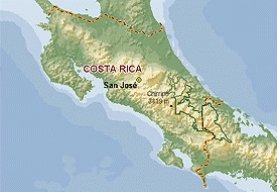
A country without an army
Costa Rica has often been called the "Switzerland" of Central America. The country enjoys an remarkable political stability. Since its independence from Spain almost all governments have been democratically elected. The constitution prohibits the set-up of an army and a social security net is well established. A large percentage of the population enjoys relative prosperity. In the beginning of the 19th century, the government did not promote big land ownership but gave away large areas to small farmers, a policy different from the neighbouring countries. Many people moved from the cities to the country at that time. This move led to a distinct rise in the coffee production. Today, more than 50 percent of coffee plantations are still smaller than 4 hectare.
Costa Rica's second important export product, bananas, has left its imprint on the landscape in the last 50 years. Where once tropical rainforest grew, nowadays bananas grow on plantations. But by now coffee and bananas are not the most important currency earners - it is tourism. That may be one reason why the Costa Rican government increasingly supports the fight of conservationists for the conservation of nature. More than a quarter of the country's land areas has been turned into nature reserves. These national parks with their colourful birds, wonderful orchids and exotic reptiles may hold as many as half a million plant and animal species.
In 1987 Costa Rica gained international recognition when the Nobel peace prize was awarded to the then President, Oscar Arias Sanchez, for his efforts in the peace talks during the El Salvador and Nicaragua conflict.