
1. June - 31. October 2000

Guyana

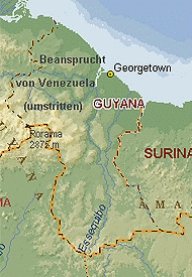
Country of many rivers
The Indian natives called Guyana the "country of many rivers". Numerous rivers flow through the country situated in the northeast of South America. The majority of the population lives along the coast. The rest of the country is only sparsely populated. 80 per cent of the land are covered by rain forests. The coastal plain is partly alluvial land lying up to 1.50 metres below sea-level. It is protected from the Atlantic by dams and dykes. This is the most fertile area of the country.
The Spanish who discovered Guyana around 1500 did not show much interest whereas the British, French and Dutch kept fighting for dominance over decades. They finally agreed in 1814 on the division of the country. In 1966, British-Guyana became independent as Guyana.
The population is a rather colourful mix. Apart from the indigenous Indian (Amerindians) population there are African slaves who settled in the country after the abolition of slavery. To replace them as workers, indentured workers from East-India were brought into the country. They constitute half of today's population.
Guyana is the only country on the South-American continent with English as the official language. However, 14 different languages and dialects are spoken in the country. The inhabitants feel politically, culturally and historically connected with the Caribbean rather than the South-American continent.