


1. June - 31. October 2000

Paraguay

Life along the river
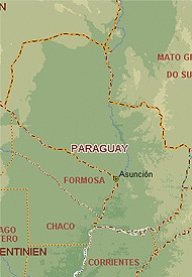
As a landlocked country, Paraguay owes its name to its most important river. The navigable rivers, the Paraguay in the north, the Parana in the east and the Pilcomayor in the southwest, are the lifelines of the country. They connect Paraguay with the far away Atlantic Ocean and are irreplaceable as energy providers and routes of transport.
Searching for gold, Spanish adventurers crossed the river Paraguay in 1537. They built a fort where the capital is nowadays. Starting in 1609, Jesuits built so-called "reducciones", Indian villages in which the Jesuits taught the indigenous population - the Guarani. They founded a Jesuit-State in which the culture of the Guarani experienced a new prosperity. The unusual experiment survived until 1767 before falling victim to white settlers. The Jesuits were driven from the country and most of the Guaranis killed. Yet until today, Guarani is the second official language besides Spanish and widely understood and spoken.
From 1776, Paraguay belonged to the Vice Kingdom Rio de la Plata whose administrative centre was Buenos Aires. In 1813, Paraguay declared independence. About 50 years later, the "Big War" broke out, an attempt Paraguay's to fight domination by the overpowering neighbour countries Brazil and Argentina. In the war Paraguay lost large parts of its national area and about 80 per cent of its population.
Today, there is transnational cooperation between Paraguay, Brazil and Argentina in the field of water power. In 1989, after 35 years, dictatorship was abolished. Elections are now held every five years as laid down in the new constitution that came into effect in 1992.