1. June - 31. October 2000

Egypt

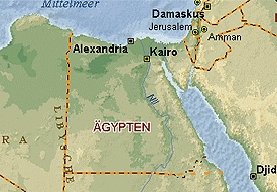
"Mother of the Earth"
The Egyptians call their country "Mother of the Earth". The people of Egypt are deeply conscious of the fact that they live in one of the most ancient states in the world.
Already 5,000 years ago King Menes united the various peoples who populated the Nile into a single nation. The tombs of the Pharaohs, the pyramids, which date back to that period, today attract millions of tourists.
Egypt was ruled by native overlords for almost 3,000 years until it was conquered by Alexander the Great in the year 332 BC. He founded Alexandria, by the Mediterranean Sea, a town which was to develop into a cultural centre of the Hellenistic world. It was here that Anthony and Cleopatra resided. In the year of Queen Cleopatra´s death, in 30 BC, Egypt became a Roman province and later part of the Byzantine Empire. This period saw the founding of the Coptic Church, to which most Egyptian Christians (some ten per cent of the population) today belong.
From 640 onwards Islam began to spread, and Egypt became part of the Ottoman Empire, if a notably independent part. In the 18th century Mohammed Ali began a process of modernisation in the country. In 1869 the Suez Canal was opened. However, extreme debt forced the ruling family to sell its shares in the canal to Great Britain. Egypt became a British protectorate in 1914 and in 1922 it became officially independent as a monarchy.
Egypt's independent political role as a leading power in the Arab world began in 1954 with the overthrow of King Farouk. Gamal Abdel Nasser, the first president of the Republic of Egypt, implemented a land reform, awarding millions of fellahin, Egyptian peasants, a piece of land. The nationalisation of the Suez Canal Company in 1956 caused international outrage.
During the Six Day War in 1967 Egypt lost the Sinai Peninsula to Israel. The Camp David treaty settled the final pulling out of the Israeli troops (in 1982) and peace with Israel.