1. June - 31. October 2000

Albania

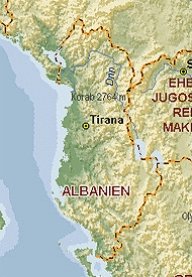
Land of eagles
Sons of Eagles or Shqiptare - that is what the Albanians call themselves. For decades in political and geographical isolation, they appeared in the headlines in the nineties. First in 1991, when desperate Albanian families tried to reach Italy with by boat, and 1999, when the Kosovo conflict made Albania a country for Ethnic Albanians from Kosovo to flee to. The extremely poor population did not hesitate to help the refugees.
The history of the land of Shqiptare goes back to 900 BC. Along the Ionian coast Greek settlements sprung up. The ancient Illyrians, of which the Albanians are descendants, were defeated by the Romans in 229 BC and the land became a Roman province. Today's Albanian language can be traced back to the Illyrian tongue - the only surviving language of the Indo-European Language family of its kind. The two main dialects are spoken by the two main groups of the population: Geg is spoken in the North and Tosk is predominant is the South. After 400 years of Turkish rule, Albanian was made an independent duchy in 1913 by the European powers. Under the pressure of the neighbouring countries, Kosovo was turned over to the Serbs, and parts of the South to Greece.
During World War II, Italian and later German troops occupied Albania. After the war, the people's Republic of Albania was founded on 11 January 1946. The President Enver Hoxha ruled the country up to his death. In the sixties he severed political ties with the Soviet Union and approached China. The infamous secret police Sigurimi terrorised the people. Only after Hoxha's death in 1985 the country has started slowly to open up.