



1. June - 31. October 2000

Bangladesh

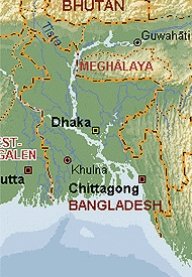
Land of rivers
Rivers have a decisive influence on life in Bangladesh. The lives of a large proportion of the population depend directly on the water of the Ganges, Brahmaputra and Meghna, which guarantee the fertility of the soil. The lowland, which lies only a few metres above sea level, yields up to three harvests a year.
Many immigrants and foreign rulers have been attracted to this fertile country. Under a ruling Muslim dynasty a large section of the population of Bengal converted to Islam in the 16th century. In colonial times Bangladesh was a province of British India. Upon the independence of India the region of Bengal, with its predominantly Muslim population, was annexed to Pakistan. The next 25 years were marked by struggles for greater autonomy. They came to an end in December 1971, when Bangladesh achieved national independence.
The native Bengali language is of central importance to the national identity of the Bengalis. Already in 1913 Rabindranath Tagore was awarded the Nobel Prize for Literature. The national anthem, too, is based on a text by Tagore.
Bangladesh´s economic successes include a high rate of growth which has lasted for years now. Internationally acclaimed programmes have been developed to fight poverty. However, with the highest population density of any state in the world, overcoming social poverty proves a quite formidable task. The further development of a parliamentary democracy is of central importance here.
However, the country´s foremost problem is its rivers. Rising waters, monsoon rain and whirlwinds regularly lead to flooding and have taken their toll on over a million lives since 1970. Shelters today offer the people more safety, yet cannot prevent the destruction of their infrastructure and crops.