


1. June - 31. October 2000

Benin

Ancient kingdoms
When the first Portuguese seafarers reached what is now Benin, the western coast of Africa was home to numerous kingdoms in their prime. The early European travelers gave amazing accounts of the magnificence of the palaces and the wealth of the town of Benin, which lay in the area now known as Nigeria. They brought home sculptures of bronze, brass and ivory, which hinted at the life in the courts of the rulers.
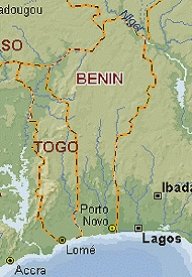
Also within the territory of the Republic of Benin, whose present-day borders date back to the French colonial period, there were independent kingdoms with their own languages and cultures. The most powerful in the 16th and 17th centuries was the kingdom of Allada, which was later superseded by Dahomey. The power of Dahomey was based on its well-disciplined army, which also included a women's unit. The rulers succeeded in uniting the very different communities. As the Fon they developed their own individual national identity, and today represent 40% of the population of modern Benin.
As early as in 1851, the French signed a trade treaty with the King of Dahomey. But it was not so much the palm oil as the colonial rivalry with Britain which prompted France to conquer the land with military force. Against a background of resistance from the successor King Behanzin, Dahomey was incorporated into the French colonial territory in West Africa.
The country gained independence in 1960 under the name of Dahomey. After a military coup it became the "People's Republic of Benin" in 1975. After a period of socialist economic policy, the head of state Kérékou himself introduced the liberalization of the economy and society. In the presidential elections in 1991 he lost to his opponent, but was re-elected five years later.
Benin is an agricultural country, self-sufficient in basic foodstuffs such as millet, maize, rice beans and cassava. Oil palms, cotton, peanuts, cocoa and coffee are grown for export.