

1. June - 31. October 2000

Bulgaria

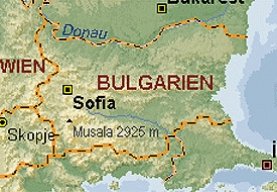
The cradle of Cyrillic letters
Bulgaria is seen as the cradle of Slavic culture. The first Bulgarian Empire was already founded in 681. Christianisation set in during the 9th century. The numerous cloisters were also cultural centres. The Slavic missionaries Methodius and Kyrill were instrumental in developing the Old Bulgarian language into the church language of the Eastern church similar to Latin in Western Europe. Here, the Cyrillic letters also used in the Russian language have their origins.
In the 14th century Bulgaria fell to Turkish foreign rule lasting until the end of the 19th century. The Bulgarians could nevertheless hold on to their own language, culture and religion. In the Russian-Turkish War (1877/78) a broad Bulgarian national movement started and in 1908 independence was proclaimed. In the following years many wars shook the Balkan region. But Bulgaria could not re-establish its former historical role as a leading power in the region.
In 1946 the Bulgarian monarchy was abolished by a referendum and the People's Republic of Bulgaria was declared. From 1971 until 1989 Todor Zhivkov was the head of state known to be a definite hardliner among the East bloc leaders. He disagreed with Gorbachev's policy of Perestroika but younger party colleagues forced him to step down in 1989.
Since July 1991 Bulgaria is a parliamentary Republic. Due to the economic difficulties more than one government had to go. Bulgaria received an IWF loan of 1.6 billion US dollar in August 1998 to finance necessary structural reforms. Bulgaria is one of the countries with which the EU is holding talks about EU membership.