



1. June - 31. October 2000

Djibouti

Along the Incense Route
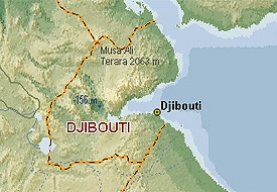
From a cosmonaut's-eye view, the distinct features of Djibouti's geology are clearly visible: Nowhere else is the Earth's crust so thin. Volcanic magma bubbles only 7,000 meters beneath the surface. Djibouti lies in the middle of a big rift valley, on the point where Africa separated from Asia and has since drifted in a westerly direction.
Farming was barely feasible on the hot land with its black lava soil and white salt lakes. But it happened to be along the old trade routes, which connected the Mediterranean and the Arabic Peninsula with East Africa and the Indian Ocean. Since the building of the Suez Canal, the colonial powers saw an increased strategic significance in the strait between the Red Sea and the Gulf of Aden. France used money and goods to acquire settlement rights along the Bab al Mandeb from the Afar sultans of Obock (1862) and the sultan of Tadoura (1884). Djibouti became the capital of the "French Somaliland" colony and a newly-built railway now connects its deep-sea port with Ethiopia.
Djibouti was the last African country to gain independence in 1977. Its internal politics are mainly marked by the rivalries of the two most important communities Afar and Issa, both of which were originally nomadic.
As natural resources and farmland are basically non-existent, Djibouti has developed an efficient service sector, which produces approximately three-quarters of the gross domestic product. Apart from the transportation of goods, the French military stationed in the country provide its other source of income. Furthermore, Djibouti boasts a modern container port, which also offers cold storage. The airport's excellent facilities and the best telecommunication services in the area have made the country one of the region's most important trans-shipment centers for international aid.