
1. June - 31. October 2000

Gambia

Country by the river
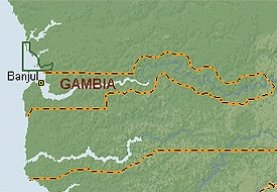
Gambia juts into Senegal like a finger. The small state on the banks of the Gambia River owes its unusual shape to the clashes between the French and British colonial powers.
Before colonialism, this region belonged to the merchant empire of Mali, which reached its heyday between the 13th and 16th century. The kings of Mali had links to the Maghreb and to Egypt, and valued Islam for diplomatic and economic reasons.
British presence began with a military base, built to control the slave trade. Bathurst, today called Banjul, was founded at the mouth of the Gambia River. Current borders of the country, 477 kilometres long and only 25 to 40 kilometres wide, were established in 1889 by the French and British.
Gambia became independent in 1965. After Senegal supported the Gambia president in suppressing a military coup, the two countries agreed to a confederacy - Senegambia - though this was dissolved after just a few years. Even though Gambia is politically independent, it remains closely allied to Senegal. Their populations are made up of the same ethnic groups: Malinke (Mandingo) and Wolof in the central part of the country, Peul and Sarakolé in the east and Diola in the west. Wooded savannah is predominant in both countries. As a member of the British Commonwealth, Gambia plays a specific role in West Africa, which is francophone and closely tied to France. The government maintains close relations with Nigeria and Libya. The economy of Gambia, much like that of its neighbouring country, is largely based on peanut growing and exportation. The income from tourism in this region has decreased dramatically since the most recent political turmoil.