

1. June - 31. October 2000

Palestinian Authority

Land and Peace
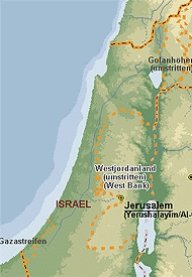
There are some 8.5 million Palestinians worldwide. Half of them live within the borders of Palestine: more than three million in the West Bank and Gaza Strip, in areas now administered by the Palestinian authorities, one million of them are Israeli citizens. Two-and-one-half million Palestinians live in exile in Jordan. They are Jordanian citizens, but are also registered as Palestinian refugees. There are also large groups of refugees in Lebanon and Syria, and the rest are scattered all over the world. As a result of displacement and occupation, the Palestinians are a people without a country and without a state.
After World War I, the Ottoman empire in the eastern Arabian region devolved to the British and French - against the wishes of the Arab League. Palestine came under British mandate, but with two diametrically opposed national claims: that of the Palestinian Arabs and that of the Zionist movement that wanted to set up a Jewish state in Palestine.
Conflict was unavoidable. Palestinian Arabs, primarily established farmers, saw their livelihood threatened by the constantly rising number of Jewish immigrants and settlers and began to defend themselves. As the situation in Palestine slipped out of British control, they returned their mandate to the UNO. In 1947, the United Nations General Assembly recommended the division of Palestine in a Jewish and an Arab part and the internationalization of Jerusalem.
In 1948 and 1967, in two wars, Israel occupied the entire former British mandate of Palestine. More than one million Palestinians were displaced; Israel occupied the West Bank and the Gaza Strip in 1967.
What followed were bitter years of fighting until both sides finally recognized each other. The world now recognizes the right of the Palestinians to a separate state within the borders of the region occupied by Israel in the 1967 war. The crux of the problem of lasting peace is the status of Jerusalem that is also indispensable to the Palestinians as their capital city.