
1. June - 31. October 2000

Russian Federation

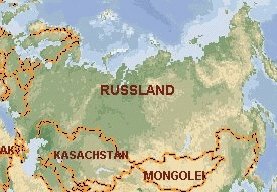
The largest multinational state of the world
More than 60 different peoples with their own languages and cultures live in the Russian Federation. It is therefore the largest multinational federal country of the world. There are 21 federal republics for non-Russian nationalities. Besides the Russian-orthodox religion, Islam is practised, and in the Asian part of the Federation Buddhism as well.
The Ural Mountains stretching more than 2000 kilometres from the North to the South is the traditional boundary of Europe and Asia. East of the Ural Mountains lies Siberia with its immense natural resources. To transport the raw materials, the Trans-Siberian Railroad was build at the end of the 19th century. It connects Moscow with Vladivostok on the Pacific coast covering a distance of 9289 kilometres which makes it the longest railroad in the world.
At the time, inner unrest shook the Russian Tsar's Empire. Tsar Alexander who had abolished slavery in 1881 was murdered by revolutionaries. Disastrous defeats in World War I further weakened the reign of the Tsar. It ended in 1917 with the Russian Revolution.
After a civil war lasting more than 3 years the Union of the Socialist Soviet Republic was declared, existing until 1991.
On 25 October 1991 the Russian Federation was founded as the successor state of the Socialist Soviet Republic. The Soviet Union had broken apart not least due to grave economic problems. The last Soviet President Gorbatchev has to be thanked for a relatively peaceful radical change in the largest country of the world. Gorbatchev prepared the way for democratisation with his policy of opening the country and reforms (Perestroika and Glasnost).
Russia is a traditional cultural nation. The Russian ballet is world famous and popular. The Russian avant-garde artists like Malevich and Kandinsky influenced European painting. The Russian literature of the 19th and early 20th century is especially rich with authors like Dostojevsky, Pushkin, Tolstoy, Turgenjev, Gogol and Gorky. Orchestras worldwide perform works by Tshaikovsky, Rachmaninov, Stravinsky and Shostakovich.