

1. June - 31. October 2000

Eritrea

Along the Red Sea
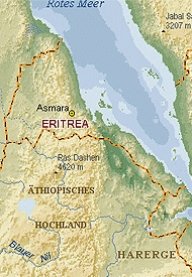
It's from "Mare Erythraeum" - Latin for the Red Sea - that Eritrea got its name. And the Red Sea should determine its history well into modern times.
More than 3,000 years ago, Semites came across the Red Sea from the southern Arabic kingdom of Sheba and built the legendary kingdom of Aksum in the area today covered by Eritrea and the Ethiopian province of Tigre. In its heyday in the 6th century, its influence reached as far afield as Egypt and Yemen. Aksum undertook trade with the Hellenistic world and accepted the Christian Faith in the year 330. After its downfall, the Eritrean area remained under the influence of the Ethiopian kingdoms. However, it was still able to maintain a certain degree of independence.
In the 16th century, the coast and the port of Mitsiwa (Massaua) were from time to time occupied by Turkish troops. With the building of the Suez Canal, the colonial and regional powers became increasingly interested in the residents along the Red Sea. Ethiopia, Egypt, the Ottoman Empire and Italy competed for the control of the coast of Eritrea. Italy won the race and in 1890 the colony of Eritrea was founded. After the Second World War, a UN resolution stipulated that the country be attached to Ethiopia as an autonomous region. In 1962 Ethiopia annexed Eritrea - not least in order to retain access to the sea.
A 30-year-long fight for independence began. In May 1993, the Republic of Eritrea was finally proclaimed. But to this day, conflicts about the border line lead to fighting again and again.
In contrast to the almost unbearably hot and partially barren coastal strips, the highlands of Eritrea are densely populated. There is enough rain here in the summer to make farming possible. However, the country has yet to recover economically from the consequences of war.